Physical Address
304 North Cardinal St.
Dorchester Center, MA 02124
Physical Address
304 North Cardinal St.
Dorchester Center, MA 02124


A tissue microarray (TMA) is an advanced technique that enables simultaneous analysis of dozens—or even hundreds—of tissue specimens on a single slide. By consolidating multiple cores of preserved tissue into a single paraffin block, TMAs provide researchers and clinicians with a cost-effective, efficient, and standardized platform for high-throughput studies. Over the past several decades, this method has transformed cancer research, biomarker validation, and diagnostic pathology.

The idea of arranging multiple tissue specimens into a single block originated in the 1980s, when pathologist H. Battifora introduced the first prototype. Early methods—such as the so-called “sausage” block—were limited in precision and usability.
Improvements came with Battifora and Mehta’s checkerboard approach, which organized samples into defined coordinates. The methodology was later refined by Wan et al., who introduced the punching technique, still widely used today.
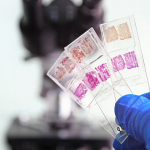
In practice, TMAs are created by extracting cylindrical tissue cores from donor paraffin blocks using specialized needles (ranging 0.6–4.0 mm in diameter). These cores are then transplanted into a recipient paraffin block, creating a grid-like structure where each tissue sample can be mapped and identified. Once the recipient block is assembled, it can be sliced into thin sections (2–5 μm) and mounted onto glass slides for staining and analysis.
This system allows hundreds of tissue samples to be tested under identical experimental conditions, dramatically increasing both reproducibility and throughput.
Compared with traditional single-sample slides, TMAs offer several distinct benefits:
High Efficiency – Hundreds of samples can be processed in a single experiment, saving time and cost.
Material Conservation – A single donor block can provide 50–500 sections, making rare or valuable tissues go further.
Standardization – All specimens are stained and processed together, reducing variability across experiments.
Clinical Relevance – TMAs can be annotated with patient information such as Gleason scores, treatment history, and outcomes, enabling translational studies.
For rare tumor types, TMAs maximize the use of limited material, ensuring that multiple laboratories can access the same high-quality resource without depleting the original tissue block.
Since their introduction, TMAs have found broad application across clinical and research fields. Their primary uses fall into several categories:
Predictive TMAs – Used to evaluate drug responses, test therapeutic antibodies, or identify drug-resistant markers.
Control TMAs – Provide consistency in experimental conditions, minimizing variation between batches of tissue staining.
Validation TMAs – Corroborate molecular findings, such as confirming biomarker expression in large patient cohorts.
Prognostic TMAs – Evaluate tumor progression and predict disease outcomes through molecular and histological analysis.
Progression TMAs – Capture snapshots of tumors at different stages, allowing researchers to track genetic and phenotypic evolution.
These applications have been especially impactful in oncology, where TMAs are used for biomarker discovery, immunohistochemistry (IHC) validation, and molecular profiling. Beyond cancer, TMAs are increasingly applied to fields such as cardiology, neurology, and placental research.
Despite their versatility, TMAs are not without challenges. The small size of tissue cores means they may not always capture the full heterogeneity of tumors, particularly in cancers with complex microenvironments like hepatocellular carcinoma. Additionally, variability in tissue fixation or block preparation can affect antigen preservation.
Nevertheless, studies consistently show that TMAs capture the majority of relevant biomarkers with high accuracy—often exceeding 90% correlation with whole-tissue analysis. This makes them a highly reliable and cost-effective alternative to large-scale tissue processing.
Tissue microarray technology continues to evolve alongside digital pathology and automation. Key advancements include:
High-density arrays – Capable of holding over 1,000 samples per block.
Automated tissue arrayers – Machines that core, transfer, and record samples with minimal human intervention.
Digital imaging – High-resolution slide scanners create virtual slides that can be analyzed with AI algorithms to detect patterns in staining and morphology.
Integration with molecular profiling – Combining TMAs with next-generation sequencing (NGS), proteomics, and transcriptomics to provide multi-layered biological insights.
Alternative formats – Including frozen tissue arrays and cell line microarrays for specialized research needs.
These innovations will make TMAs even more essential in precision medicine, global collaboration, and large-scale biomarker discovery.
From their origins in the 1980s to their present role in oncology and translational research, tissue microarrays have become indispensable tools for high-throughput tissue analysis. By conserving precious specimens, standardizing staining, and linking pathology to clinical data, TMAs bridge the gap between laboratory research and patient treatment.
As automation, digital imaging, and molecular integration continue to advance, TMAs are set to remain at the forefront of biomedical discovery, supporting both clinical diagnostics and innovative cancer research.
Learn more about ArraysBank’s tissue array and FFPE solutions and explore how our resources can accelerate your research.