Physical Address
304 North Cardinal St.
Dorchester Center, MA 02124
Physical Address
304 North Cardinal St.
Dorchester Center, MA 02124

There exists a peculiar and profound artifact in the realm of medical research: a melanoma tissue array annotated with survival data. It is not merely a scientific tool; it is a Mirror of Fates. Each tiny core of tissue, a pinprick of tumor, is not just a biological sample but a reflection of a human life, a frozen echo of a personal battle against a particularly mercurial foe. And etched beside it, the cold, hard numbers of survival data—the months, the years—serve as the epitaph, the final measure of that struggle. To gaze upon this array is to stand before a gallery of ghosts, each with a story to tell about the nature of luck, genetics, and the brutal lottery of cancer.
This mirror does not show a simple image of life or death. It reflects a complex spectrum of destinies. One core, stained intensely for a certain protein, might belong to a patient who succumbed swiftly, their story a brief, fierce tragedy. Beside it, another core, perhaps looking more aggressive under the microscope, but lacking that protein, belongs to a survivor, a veteran who has lived a decade beyond their diagnosis. The array, in its silent, grid-like arrangement, forces a confrontation with these paradoxes. It presents a hundred variations of the same disease, each linked to a different outcome, and challenges the researcher to find the invisible thread that connects the tissue’s appearance to the patient’s fate.
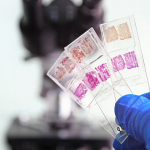
The work with this mirror is an act of forensic chronology. The survival data provides the final chapter of each patient’s story. The researcher’s task is to travel back in time, to the moment that tissue core was biopsied, and find the clues that foreshadowed the ending. They search for biomarkers—the molecular tea leaves at the bottom of the cellular cup—that might have predicted a long survival or a rapid decline. Is it the presence of a specific mutation that acts as a malevolent oracle? Is it the density of immune cells infiltrating the tumor, a sign of a valiant, albeit ultimately losing, internal army? Each stain applied to the slide is a question posed to the past, and the pattern of staining across the array is the universe’s fragmented answer.tissue block
This is research imbued with a unique weight. Every data point is a life, every statistical correlation a reflection on a human legacy. The goal is not to satisfy morbid curiosity but to wrest a form of prescience from this retrospective mirror. By understanding which features in the tissue corresponded to which fate, researchers hope to build a new kind of mirror for the future—one that can be held up to a newly diagnosed patient. This future mirror would not show a fixed destiny, but a probabilistic glimpse, a forecast that allows for more personalized, more effective treatment. It aims to transform the Mirror of Fates from a tool of post-mortem reflection into a shield, a guide, a beacon of hope for those still navigating the treacherous waters of the disease. In the end, the melanoma array is a somber reminder of all that has been lost, but it is also the very key to ensuring that future reflections in this mirror are of longer, healthier lives.