Physical Address
304 North Cardinal St.
Dorchester Center, MA 02124
Physical Address
304 North Cardinal St.
Dorchester Center, MA 02124

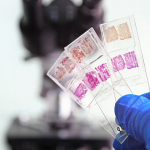
To the uninitiated, it is a sliver of glass, stained with a wash of pinks and purples, a seemingly abstract watercolor. But to the pathologist, it is a map. Not of lands or oceans, but of a human soul’s final, silent testimony. This stained tissue section is a topography of a life, a frozen moment in the epic saga of a single body, and the pathologist is its cartographer, trained to read the contours, the rivers, the ruins, and the subtle shifts in the terrain that whisper the story of disease.
The process of creation is an alchemical art. The raw material, a fragile piece of flesh, is fixed, embedded, and sliced into impossibly thin sections, mere microns thick. This is the preparation of the canvas. Then, the stains are applied. Hematoxylin, the deep, celestial blue, binds to the acidic nuclei, staining the dense repositories of genetic code—the cities and capitals of the cell. Eosin, the soft, earthy pink, colors the cytoplasm and extracellular proteins, the sprawling landscapes and connecting highways. This H&E stain is the cartographer’s primary tool, creating a high-contrast world where the fundamental structures of life and its corruption are rendered visible.
Reading this map requires a literacy that transcends words. The pathologist’s eye scans the terrain, recognizing the familiar geography of health: the orderly architecture of a gland, the uniform brickwork of epithelial cells, the quiet, meandering flow of a capillary. But they are searching for the anomalies, the signs of a cataclysm. They see the “urban sprawl” of a tumor, where chaotic, misshapen cells pile upon one another, ignoring the ancient laws of cellular society. They identify the “battlefields” of inflammation, where white blood cells, the immune system’s infantry, have amassed to fight an unseen invader. They map the “floodplains” of edema and the “scorched earth” of necrosis, where tissue has died from lack of supply.tissue bank tissue section
This is a discipline of profound inference. The cartographer is not present for the event, only for its aftermath. A misshapen nucleus is not just a shape; it is a historical record of a mutation, a tyrant’s decree issued from within the cell’s control center. An abnormal mitotic figure is not just a dividing cell; it is a sign of reckless, unchecked proliferation, a civilization expanding too fast for its own good. The arrangement of cells, their relationship to one another and their environment, tells a story of invasion, of defense, of cooperation, and of betrayal. The pathologist must be both a historian and a detective, piecing together a narrative from a single, static scene, understanding the processes that led to this frozen moment.
For the trainee, learning to read these maps is an initiation into a secret world. It is about training the eye to see what is present, but more importantly, to understand what is absent, what is broken, what is unnatural. Each slide is a new country to explore, with its own unique dialect of disease. The stained tissue section is, therefore, more than a diagnostic tool. It is a profound dialogue between the living and the once-living, a silent language spoken in the universal grammar of cells. And the pathologist, the humble cartographer of souls, holds the key to its translation, guiding the course of treatment with the wisdom gleaned from reading the land.